Anencephaly Infant Organ Donation Survey
American public survey suggests meaningful support for organ donation from anencephalic (terminal) babies.
Anencephalic or hydranencephalic infants—born without most of the brain—are terminal but otherwise healthy; their organs could save thousands of other infants, but harvesting requires extraction before cardiac arrest damages viability, which is technically murder. The practice has been done (most famously Baby Gabrielle in 198739ya, whose heart recipient was reportedly still alive at 37), but remains rare and controversial.
How controversial? I expected <10% of Americans would endorse such organ donation. And since it’s now easy to survey the American public on such questions, I went ahead and ran a quick survey in November 2025.
Surprisingly, a US-representative Prolific survey (n = 300, ~$86) suggests more support than I expected: 40% endorse pre-mortem donation. Only 7% oppose even post-mortem donation. However, 50% express high concern (4–5/5) about slippery-slope risks.
When the choice is framed as a brainless body versus a dying child, a plurality seem willing to break the taboo.
Anencephaly babies are babies born without most or all of their brain; there is no one “there” and never will be, and the bodies are usually allowed to die despite otherwise often being perfectly healthy. (Indeed, if cared for, some bodies have lived into adulthood!)
Anecenphalic Organ Donation
Since the bodies are healthy and could in theory be donated to science, this raises the bioethics question of whether they should be—there are otherwise no infant organs available for organ transplantation into other infants. (While the parents can give consent, the organs are damaged by cardiac arrest, and the body needs to be alive in the sense of heart beating & lungs breathing when the organs are donated, but doing that would technically be murder. This is a little trickier than usual because of the problem of “brain death” ie. there is no brain to die.)
History
This is not an exotic hypothetical: I was surprised to learn that this had already been done a number of times—dating back to 1966 by Adrian Kantrowitz (he failed due to waiting for cardiac death), but most famously in the 198739ya case of “Baby Gabrielle”. Baby Gabrielle was a Canadian anencephalic baby whose heart was controversially transplanted in a Californian infant, Paul Gabriel Bailey Holc (described as alive and well at age 28 with 1 son, and was reportedly alive at age 37). However, the practice remains extremely rare.
Public Acceptability
Regardless of how lifesaving it would be, the idea seems like it would be very unpopular with the general American public. (Assuming away the practical issues like how to guarantee that etc.) So unpopular that there is no realistic chance of it ever happening, some historical exceptions from more freewheeling eras notwithstanding.
I’d expect a small minority of consequentialists or pro-tech, like <10%, to endorse such positions…
But, why speculate idly about how unpopular the idea would be with the general American public when I can just ask them?
You Can Just Ask Things
It’s not hard to run a survey online, and I’ve already run surveys through the late Google Surveys & Prolific.com. And it would serve as a useful demonstration to my fellow participants in the 2025 Inkhaven blogging residency that you can run a meaningful survey quickly, cheaply, and easily, and use it in your writing.
Survey Design
So on 2025-11-13, I logged into Prolific and began setting up a survey.
First, I checked “How do I run a study with sensitive or disturbing content?”, and decided that some bioethics hypotheticals were not particularly sensitive or disturbing, so I could run the survey without special review.
From past statistical power analyses, I knew that 100–300 responses would suffice to estimate overall popularity at the level of granularity I was interested in (eg. 10% vs 50%), although it would be inadequate to do any more detailed analysis like per demographic. (It is also highly risky to do a large survey upfront without seeing any responses—there are often surprises.) This is a good thing because Prolific’s representative US population survey participants (“Factors: Sex, Age, Ethnicity (Simplified US Census)”) are more expensive than the convenience sample, and the former is what I need if I want to make claims about “the general American public”.
Then I started writing some multiple-choice questions with Claude-4.5 feedback.
Survey Questions
I settled on this:
Description: Bioethics survey of American adults on the ethics of organ donation from brainless bodies. Anonymized survey data will be made public as a CSV export.
Question 1 [1 mandatory answer]: Anencephaly is an untreatable terminal condition in which a baby is born without much of the brain or skull. The body may be otherwise healthy, but the infant typically dies within days. With parental consent, would it be ethical to surgically remove organs from an anencephalic infant in a way that would end its life, in order to preserve organ viability and save another child’s life?
Yes
[████████▒▒▒▒▒▒▒▒▒▒▒▒ 40%1]
Only after natural death
[██████████▒▒▒▒▒▒▒▒▒▒ 48%]
No
[█▒▒▒▒▒▒▒▒▒▒▒▒▒▒▒▒▒▒▒ 7%]
Unsure/Decline to answer/Other
[█▒▒▒▒▒▒▒▒▒▒▒▒▒▒▒▒▒▒▒ 5%]
Question 2 [1 mandatory answer]: How concerned are you that allowing pre-mortem organ donations from anencephalic babies could lead to abuses, such as pressure on parents or expansion to organ donations from other conditions? On a scale of 1–5 (unconcerned to very concerned)
[██▒▒▒▒▒▒▒▒▒▒▒▒▒▒▒▒▒▒ 9%]
[███▒▒▒▒▒▒▒▒▒▒▒▒▒▒▒▒▒ 14%]
[█████▒▒▒▒▒▒▒▒▒▒▒▒▒▒▒ 26%]
[█████▒▒▒▒▒▒▒▒▒▒▒▒▒▒▒ 24%]
[█████▒▒▒▒▒▒▒▒▒▒▒▒▒▒▒ 26%]
Question 3 [1 mandatory answer]: If it became possible to genetically engineer embryos to be anencephalic specifically for organ donation, should this be allowed?
Yes
[████▒▒▒▒▒▒▒▒▒▒▒▒▒▒▒▒ 19%]
No
[█████████████▒▒▒▒▒▒▒ 67%]
Unsure/Decline to answer/Other
[███▒▒▒▒▒▒▒▒▒▒▒▒▒▒▒▒▒ 14%]
Results
The minimum for a US-representative sample turned out to be 300, so I had to pay for n = 300. The survey took an average of 55s to fill out, was complete within ~9 hours And the 300 final responses cost $85.71 (equating to an hourly rate of $12 according to Prolific).
The results (full CSV):
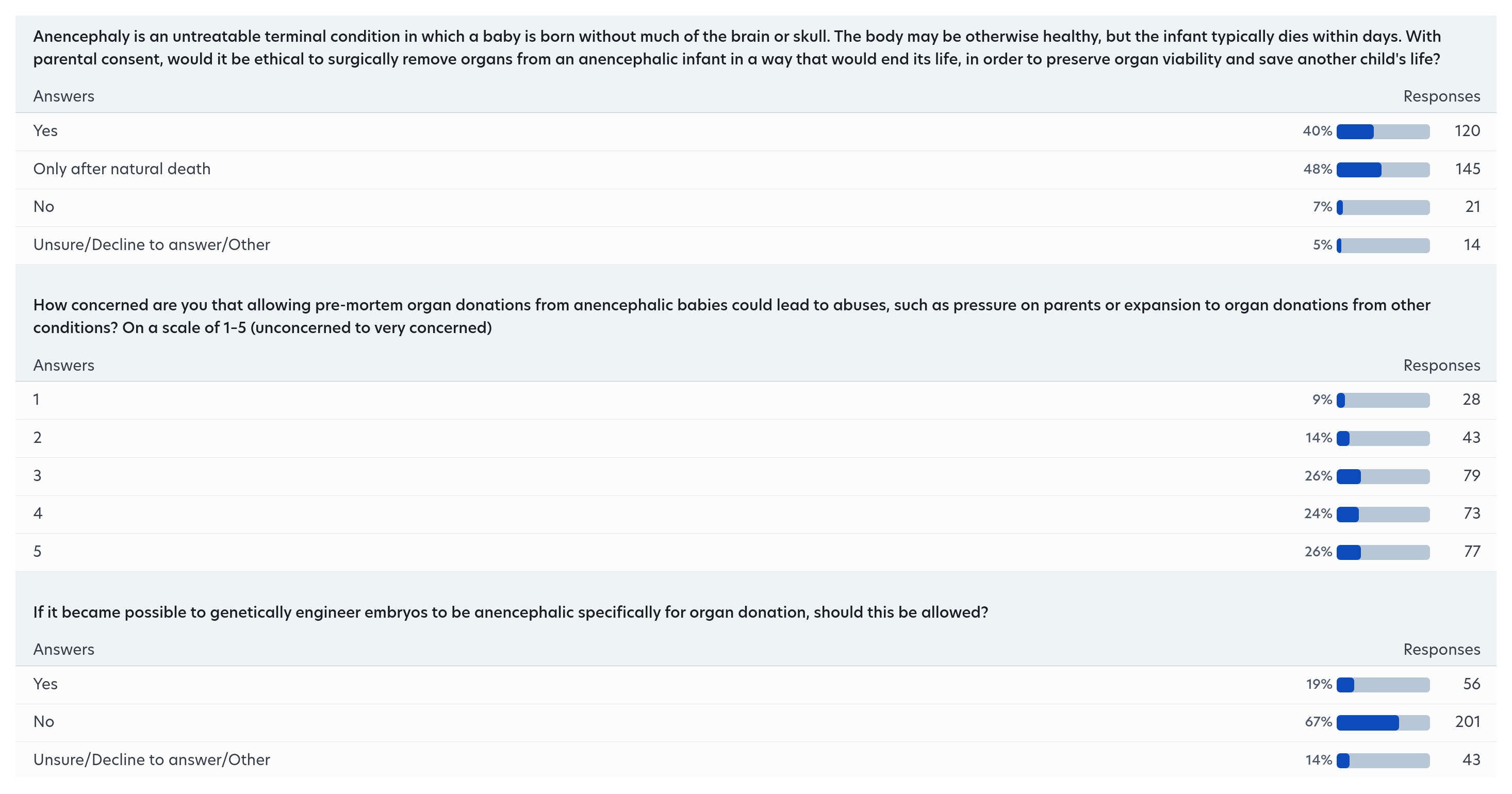
Organ donation survey results screenshot.
Interpretation
Broadly, it sounds like there is substantially more public support than I expected for natural cases (40% chose the simple “yes” to allowing it, and almost everyone else approved of a highly limited permission), and somewhat more than I expected for artificial cases (19%! far above Lizardman), but considerable concern about slippery slope or systemic problems, and the usual folk ethics distinction between commission & omission. It seems like if the choice is framed clearly—a “brainless” body versus a dying child—a plurality are willing to break the taboos, and a meaningful minority is willing to shatter them entirely.
My biggest question here is, to what extent do participants really understand the questions?
20 seconds per question seems reasonable, but I don’t know to what extent framing is driving these responses. It’s possible that permissiveness would fall a lot with different wording, and that some respondents didn’t think enough about what the moral status of a brainless body is.
I calculate no confidence intervals here because the sample size was substantially larger than intended and the random sampling error here (something like ±5%) is much less important than the systematic errors or lack of external validity of the survey and questions.↩︎