What Is It Like To Be A Cat Tail?
N/A
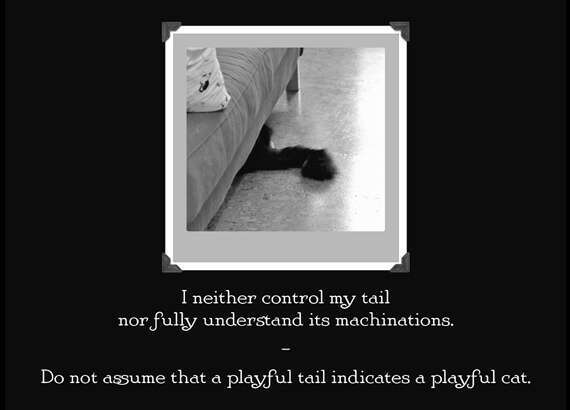
Anyone who has seen a cat (or dog) whack itself in the face with its tail, attack its tail after being surprised by it, or lay with their tail lashing only to abruptly lick it (seemingly “trying to calm it down”), must have wondered what is going on & if ‘tails have minds of their own’.
This seems… plausible, actually?
Because what makes a mind a ‘mind’ seems to be its integration; the faster and more integrated some neurons are, the more they are part of it. The further away, or slower, or unpredictable, the less they feel part of it.
If we look at split-brain patients, or octopuses (whose arms contain 3⁄5ths its neurons, and which when cut off, can still grab food & attempt to pass it back to the mouth), body schema problems like phantom limbs & treatment like mirror therapy (or using VR to induce fake-limb mental ownership, or speechjammers), the Krista and Tatiana Hogan joined-at-the-head twins (who, Peter Watts notes, avoid using the pronoun “we”), the inability of the sane to tickle themselves without an artificial delay, PRISM/pain etc., one gets the inescapable impression that personal identity is a continuum closely linked to a triangle of latency/bandwidth/predictability: brains perceive subsystems as part of themselves, rather than external objects, only if they can be sufficiently accurately modeled & controlled. At a certain point (akin to VR “presence”), identity “snaps” into place.
A well-designed tool simply feels unconsciously part of ourselves, while a poor tool constantly causes errors & problems & is hard to control quickly, repeatedly feeling alien to us, forcing its way into consciousness to be laboriously processed (a good tool transitions from “present-at-hand” to “ready-to-hand”).
Our hands feel so much closer to us than our feet (cf. the sensory homunculus), and our eyes feel so much more us than our big toe because it provides such rich information to the brain, with such low latency (being but inches away), and the saccades of our eyes are the fastest and most precise muscular movements in the body—we are entirely unconscious of eye focusing & movement, or the blind spot, because our eyes work so well. The 2 hemispheres of our brain are likewise so tightly linked by such high-speed & high-bandwidth neural connections that we have no conscious experience of brain lateralization, and cannot even conceive ‘what it would be like’ after they are surgically severed—to be just the left hemisphere or just the right hemisphere. Or more fundamentally, we are unable to notice or perceive the extensive processing brains must do to laboriously extract colors, edges, objects, temporal persistence, even when an optical illusion reveals to us the tricks and we stare at it trying to will it away: you still can’t feel the vision processing as separate from you. It just works too well, too fast, too often.
Analogously, your computer is full of tiny computers (many more than you probably realize), but they are all so closely linked, and move in concert, that you treat it as just 1 big computer (until something goes wrong); if those smaller computers were on the other side of the world, however, and it took half a second to roundtrip, you would be forced to treat them as remote servers that you are networking with. (The difference between a supercomputer and a bunch of random PCs in a P2P network over the Internet is that the individual PCs in the supercomputer are physically close together and connected by extremely high-speed networking, and that is why the supercomputer can compute many important things orders of magnitude faster than the same amount of nominal compute spread out over the world.)
How do cat tails fit in with these other examples?
A cat tail is as far away from the cat brain possible (a tail might be as long as the body itself!), and is an extension of the neuron-filled spine.
And a cat tail exists mostly for the sake of balancing (as opposed to being an escape decoy, distraction, stinger, spare hand for tree climbing etc.). Balancing in feline acrobatics like pounces is an extremely rapid process which must happen in milliseconds, with potentially fatal errors; there is no time to chat back and forth with the main brain, the tail must be relatively autonomous. (Similar to how even decerebrated cats can still do things like walk or trot. The peripheral nervous system must be quite capable in its own right!) The tail is also quite separate from the rest of the body: tail adjustments have little to do with the neighboring rear legs, eg, much less the rest.
So, a cat tail is physically remote (and thus high latency), and it needs to operate semi-independently for its function (low-latency adjustments to balance and posture). These are good conditions for cognitive independence.
It is true that a cat tail is lacking in ‘hardware’: a cat tail doesn’t contain remotely as many neurons as an octopus arm or elephant trunk does (as far as I can find out—but since octopuses have roughly twice as many as cats & put an absurd amount into their limbs, it seems highly likely), but this sort of personal identity is a continuum. (Young elephants take a long time to learn to control their trunk, and young kittens too seem to have trouble with their tail; perhaps that’s why kittens are so adorably clumsy in part, because of an uncooperative tail?)
Given the tail’s role and distance, and a continuous view of personal identity and ‘handiness’, it seems possible that a cat doesn’t quite ‘own’ its tail the way it does more tightly-integrated limbs like its forepaws, and genuinely can be surprised by what its tail ‘decides’ to do.
So, all that said, if it is like something, what is it like to be a cat tail?
It would be an extremely limited sort of mind (far above a thermostat, perhaps, but far below the main cat brain). A tail would have little or no memory beyond the seconds-scale, with senses confined to the tactile like pressure or temperature; it would always be trying to find a more comfortable position, based on signals about being in equilibrium, which signals are inflicted on it from a mysterious elsewhere (the main brain); it would sometimes successfully adjust within milliseconds, but it would still be periodically bothered by intense feelings of discomfort or predicted pain, which it attempts to fix with new positions (usually futile), until equilibrium signals are restored for unknown reasons. And when the cat screwed up, the tail would suffer greatly for reasons it can’t understand and can do little about (the tail might even die before the cat does).
Meh. It’s not a great life. But it’s a living.
See Also: