Chapter 6, Mime Molting: What to Expect
Bureaucratic-horror fiction: the molting chapter of a statutory owner’s manual for companion mimes, with glossary excerpts and a completed Grade III incident-notification form.
An excerpt from the (fictional) 4th edition of a government-issued care manual for companion mimes, covering the annual molt: preparation, the empty phase, shed material and its reabsorption, mirrors, and when to leave the room. The register is UK statutory-instrument: graded incident codes, regulation cross-references, and a revision history whose footnotes record what earlier editions promised and what later editions quietly withdrew.
The chapter is followed by glossary excerpts and a completed Form MH-7 (Molt Notification), in which one household’s Grade III event falsifies the chapter’s reassurances field by field.
Fourth Edition (200818ya). Statutory references current to the Animals (Mimetic Species) Regulations 200818ya.
[Chapter is followed by glossary excerpts and a completed Form MH-7 (Molt Notification), received by the Mimetic Welfare Unit after a Grade III event.]
Molting is a normal, recurring feature of mime ownership. A healthy companion mime molts once or twice a year, most often in late spring. The process is not painful and asks very little of you. Most of your work during a molt is the work of leaving the animal alone.
Codes used in this chapter:
[NORMAL]: No action required.
[MONITOR]: Record in the animal’s log (Appendix C).
[NOTIFY UNIT]: Telephone the Mimetic Welfare Unit. Do not enter the corner.
[EXIT]: Leave the room. Telephone from outside.
6.1 Before the Molt
A molt announces itself a week or two in advance. Your mime will test walls more often, pressing along baseboards, doorframes, and furniture edges. It may also rest its weight on supports that are not present. Do not place furniture where the animal is leaning. Its repertoire will narrow; a mime that ordinarily produces a dozen gestures may settle on 2–3 and repeat them. This is normal pre-molt behavior and does not call for new enrichment.
The clearest sign is stillness in front of reflective surfaces. A pre-molt mime will stand at a window or a dark television for long periods without gesturing. Reduce its access to such surfaces now (§6.5).
Seasonal note: spring molts predominate. Autumn molts are not abnormal in animals registered before 200125ya. An animal kept under constant artificial light may molt out of season; this is corrected by restoring a normal light schedule in February, and is rarely urgent.
Molting and travel: do not board, transport, or rehome a mime in the 6 weeks before an expected molt. A mime that molts away from home will molt to the room it is in, and the result will not serve it on its return.
Do not adjust the habitat during this period. Do not introduce a second mime. Do not clean.
6.2 During the Molt
The molt lasts 2–4 days. It takes place in a corner the mime has chosen and prepared over the preceding week. A mime without a stable corner will improvise one, most often in a doorway or a stairwell or the angle beneath a stair, and will molt there. Improvised corners are difficult to reclaim. Provide a proper corner before the season, and do not keep an adolescent mime in an open-plan room.
Maintain ordinary habitat conditions throughout:
Condition |
Range |
|---|---|
Temperature |
16–22℃ |
Relative humidity |
55–70%; raise to 75% for retained material (below) |
Lighting |
Indirect; avoid lamps that cast a single hard shadow |
Noise |
Ordinary household levels |
You will know the molt has begun when the animal becomes, in the common term, empty. Owners may report a reduced sense of occupancy in the habitat. The habitat indicator will continue to register the animal as present (green, steady). Both observations are correct, and the empty phase is normal. Continue feeding on schedule: an empty mime still takes attention, and will decline if you stop offering it. Offer attention to the registered resident briefly, and from across the room. Do not stare continuously; sustained attention during a molt can force a premature outline refill (see Ch. 3, “Feeding and Hydration”).
Whatever you find arranged in the corner, leave it. A molting mime sheds in order: the gloves first, then the soft articles, then the face. You may find these laid flat and squared to the walls, the cosmetic residue stacked apart. The squaring is exact because it is measured; no two sheds are alike because no two rooms are.1
Observation |
Action |
|---|---|
1 set of gloves, laid flat |
[NORMAL] Leave undisturbed |
Gloves adhere to open air |
[MONITOR] Raise humidity; wait 1 hour |
More gloves than the animal has hands |
[EXIT]2 |
Gloves found to fit a household member |
[EXIT] Do not allow contact |
Material that clings has not finished releasing. This is a Grade II molt and is common; raise the humidity (see table above) and wait, and it will usually release within the hour. Do not assist. Pulling retained material will injure the animal beneath, which at this stage is soft and unprotected.
Handling Warning
Do not touch the animal during the molt. A newly exposed mime takes fingerprints. These do not fade.
6.3 After the Molt
The animal re-emerges over the following day. It will seem softer at first, and slower to take its outline; its gestures will be tentative for a day or so. Through the first 48 hours, keep the household calm and avoid sharp humor, sudden laughter, and applause. A newly molted mime that is startled may abandon its new boundary and start over, and a second molt in one season is hard on the animal.
It is normal, and necessary, for a mime to consume its shed material after a molt. This is how next year’s barrier is built; a mime prevented from doing so will molt thin and incomplete the following spring. Observe the following:
Do not cut shed articles into smaller pieces.
Do not season or moisten shed material.
Do not assist reabsorption with utensils.
Do not offer shed material retained from an earlier molt.
Do not watch continuously. Continuous observation may inhibit reabsorption.
[MONITOR] Consumption may remain incomplete for up to 72 hours.
[NORMAL] Partially consumed face material is normal.
Leave the corner undisturbed until the next molt. Owners report that a corner a mime has molted in feels occupied afterward, whether or not the animal is in it.3 Under reg. 9(2) the corner must in any case be reserved for the life of the animal and may not be repurposed.
6.4 Cleanup and Disposal
Some shed material is not reabsorbed. Once the animal has finished, typically 4–5 days after the molt, collect the remainder. Wear the gloves provided and collect the residue into the lined container supplied with your habitat. Use only the gloves provided; do not substitute recovered gloves, however well they fit. Then observe the following:
Do not place shed mime material in household waste.
Do not compost it.
Do not flush it.
Do not burn it.
Disposal of mime exuviae in household waste, compost, or the public sewer is an offence under reg. 14, liable on summary conviction to a fine.4 The Mimetic Welfare Unit collects sealed containers on request. Until collection, store the container closed and away from children.
Notify the Unit of the molt within 14 days, on Form MH-7 (Molt Notification). The form records the specimen, the date, and the grade. A nil return is not accepted.
If a household member swallows shed material, by accident or otherwise, this is usually harmless. Watch the person for loss of voice over the following days. Aphonia following ingestion generally resolves on its own. If it has not resolved within 2 weeks,5 consult a physician and report the exposure.
Many owners report a strong urge, while handling shed material, to put it on. This is a known and temporary response to close contact with exuviae and passes within minutes of leaving the room. Do not indulge it. Set the material down, seal the container, and step outside. The urge means nothing, on either side.6
6.5 Mirrors
Cover or remove all mirrors before and during a molt.7 A molting mime that reaches its own reflection may molt toward it rather than into its prepared corner, which produces an incomplete and sometimes doubled result. Do not attempt to determine which result is original. If a duplicate outline is present, do not use mirrors, cameras, or reflective cookware to compare them. If two outlines answer to the same name, do not separate them. [NOTIFY UNIT]
If the habitat indicator alternates green and white after a mirror-associated molt, unplug the unit and telephone the Unit. [NOTIFY UNIT]
Household members sometimes report that the reflection completes before the animal does. This is not a malfunction of the mirror.8
Warranty coverage does not extend to reflected, partial, or duplicate molts.
6.6 Other Animals and Children
Keep cats out of the habitat during a molt. A cat that enters the corner may not reappear for several hours. Dogs may continue to react to retained material after the owner can no longer perceive it; this is not a malfunction of the dog.
Children are more likely than adults to handle shed material, and more likely to deny having done so. Inspect hands and pockets after any unsupervised access to the habitat. Do not permit a child to try on gloves, articles, face material, or an empty outline (see Appendix A; and Appendix D, “Juvenile Yearning”).
6.7 When to Call a Handler
Molts are graded I–III. A Grade I molt is complete and needs nothing from you. A Grade II molt has retained material and is managed at home with humidity (§6.2). A Grade III molt is not managed at home. A single prior Grade III event in the life of the animal is recorded at notification, but is not in itself grounds for reassessment of the animal.9
Sign |
Grade |
Action |
|---|---|---|
Complete molt; full repertoire resumed |
I |
[NORMAL] |
Material retained after humidity raised |
II |
[MONITOR] Notify if not released within 24 hours |
More gloves than the animal has hands |
III |
[EXIT] |
A second, smaller arrangement in another corner |
III |
[EXIT] |
Outline unrefilled, or refilled only partway, at 72 hours |
III |
[EXIT] |
For any Grade III event, do not remain in the room. Telephone the Unit, leave the door as you found it, and wait outside.
Most first molts resolve without handler attendance. Maintain humidity, continue scheduled attention, and do not enter the corner except as directed. The animal has done this before, even if you have not.
Appendix A: Glossary
(Relevant entries.)
Empty outline. A temporary post-molt boundary without stable animal occupancy.
Do not fold, wear, enter, or store.
Habitat indicator. The mains-powered presence lamp supplied with your habitat.
Green, steady: animal present.
Green/white, alternating: see §6.5.
The indicator does not report location.
Form MH-7
(As received by the Unit, 31 May.)
FORM MH-7—MOLT NOTIFICATION
Mimetic Welfare Unit. Submit within 14 days of molt (reg. 12). A nil return is not accepted.A. Registration
Specimen registration no.: MH-441-0907-C
Registered resident (name on certificate): “Colin”
Keeper: ____________________
Habitat reference: G/2, rear ground floorB. Event
Date of molt: 24 May
Date of notification: 31 May
Location of molt: ☐ prepared corner ☒ improvised—specify: under the stairs
Mirror present during molt? Y (note: voids warranty, §6.5)C. Grade
Grade at notification: III
Grade at collection: III
Humidity raised per §6.2? Y
Outline refill at 72 hours (%): 60
Edge definition stable? ND. Recovered material
Gloves recovered: 5
Gloves expected: 2
Difference: +3
Soft articles: complete
Face material: partially consumed (normal, §6.3)
Has this occurred previously? Y
If yes, was the recurrence single? N
(office use: refer Incident MH-2003/114)E. Household exposure
Did any household member handle shed material? Y—child; denied
Aphonia reported? Y
Duration: ongoing, day 8
Second outline observed? Y
Answers to the registered name? Y
Outlines separated? N (per §6.5)F. Containment
Reserved corner—location: under the stairs (reg. 9(2))
Container sealed and stored? Y
Habitat indicator status: green/white, alternatingDeclaration. I confirm the above is accurate, and that I have not attempted to determine which outline is original.
Signature: ____________________ Date: 31 MayFor office use only. Grade III confirmed. Handler dispatched 1 June. Do not return specimen to keeper pending assessment.
Colophon. By Gwern & Claude-5-Fable, June 2026.
A creative-writing exercise in the found-document/bureaucratic-horror mode: a pet-care manual whose reassurances are load-bearing, whose footnotes record their failure across 4 editions, and whose appendixed form documents the failure happening again.
“Mime molting” idea and Deep Research of pet law regulations/pet manuals and some revision by GPT-5.5 Pro; pet manual idea by Gwern; drafted by Claude-4.8-opus from the premise, then revised and formatted by Claude-5-Fable.
Some more mime humor:
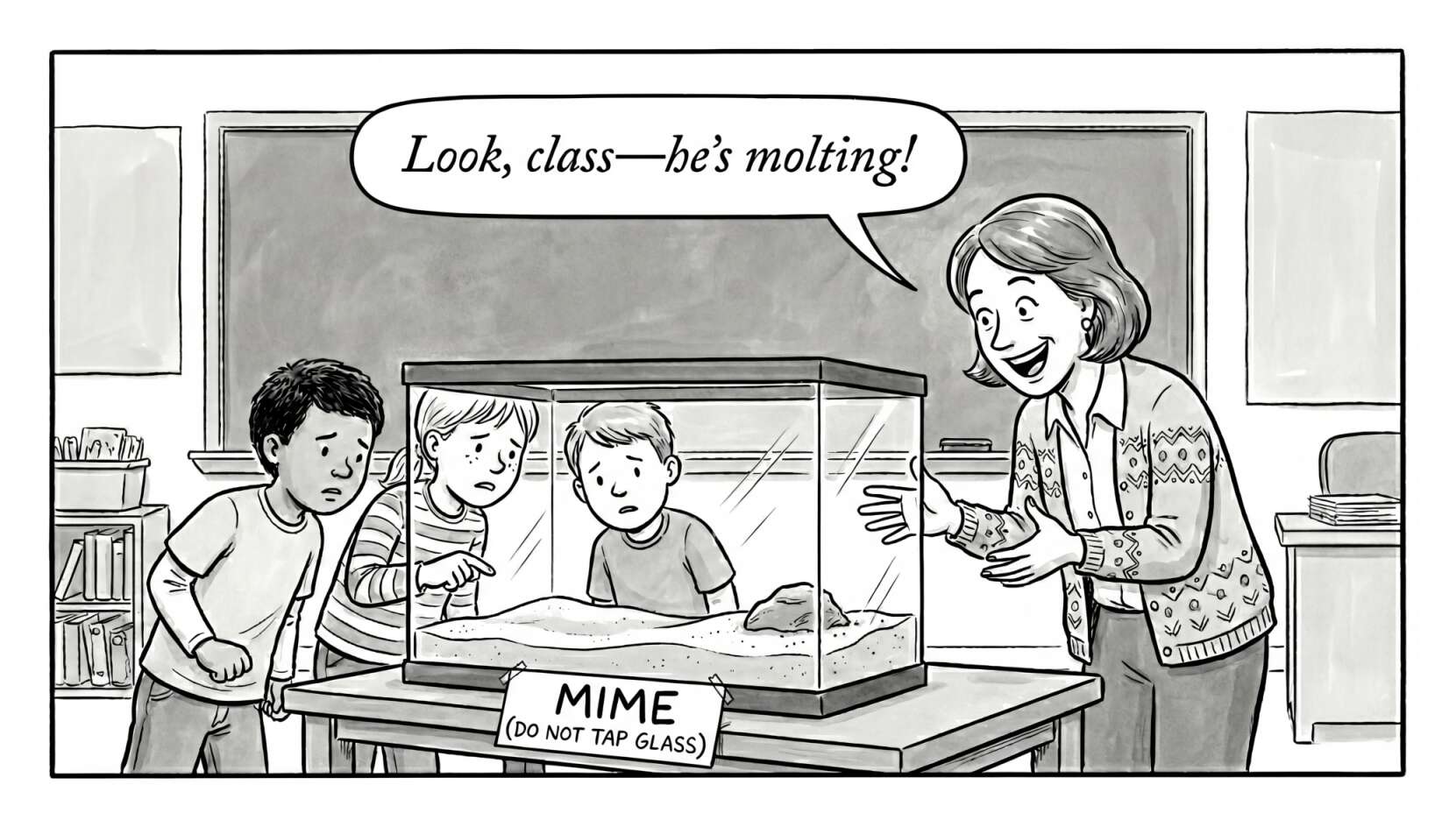
“Look, class—he’s molting!”
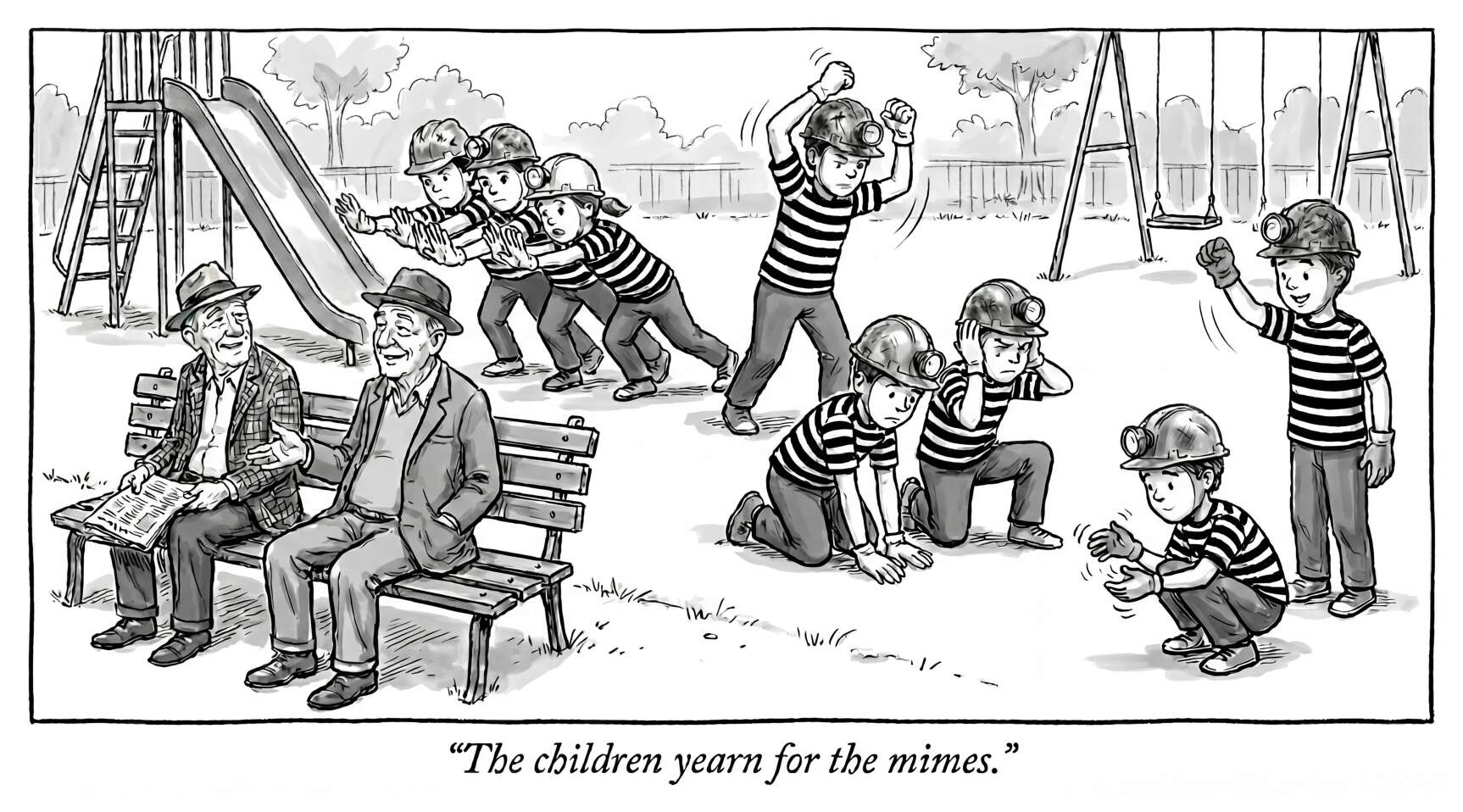
“The Children Yearn for the Mime”
A shed is an impression of the room as much as of the animal. The wall-testing of the preceding week is the animal taking the room’s dimensions; the shed is cut to fit the room it was made in. One taken from a small room will not serve in a large one, and a mime moved between molts may be unable to use a corner it did not measure.↩︎
Added in the Third Edition (200422ya), following Incident MH-2003/114.↩︎
This sentence was added in the present edition. No mechanism is proposed. ↩︎
The First Edition (198937ya) advised that shed material could be returned to the garden. That advice was withdrawn in the Second Edition (199630ya) and is now contrary to reg. 14.↩︎
Given as “several days” in the First Edition and “one week” in the Third. The interval has been extended at each revision.↩︎
Added in the Second Edition (199630ya) on the advice of the Mimetic Welfare Unit, and retained without amendment since.↩︎
Earlier editions required mirror covering only “where practical.” That qualification was removed in the present edition.↩︎
The Third Edition (200422ya) removed the phrase “harmless duplication.” The term “temporary second mime” was withdrawn.↩︎
This sentence is retained from the First Edition (198937ya). The Unit has twice recommended its deletion.↩︎