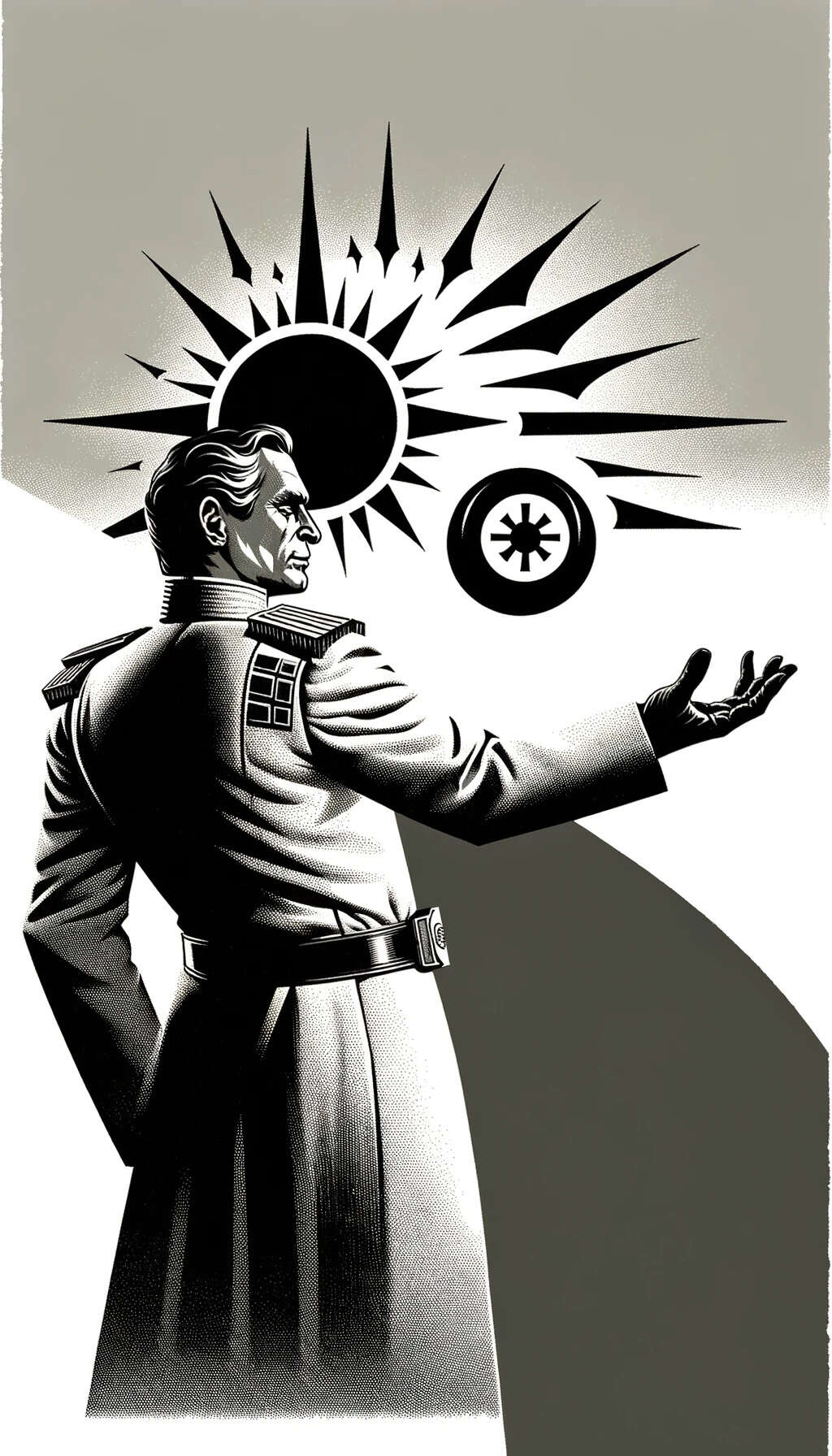
The Tragedy of Grand Admiral Thrawn
I explain the somewhat arbitrary-seeming death of the popular Star Wars character Grand Admiral Thrawn as being the logical culmination of a tragic character arc in which his twisted (or ‘thrawn’) cunning & scheming, one of his defining traits, ultimately backfires on him, causing his bodyguard to betray & assassinate him.
In the sprawling Star Wars Expanded Universe (EU), one of the most memorable characters was Grand Admiral Thrawn. Thrawn was introduced by Timothy Zahn in 199135ya in his The Thrawn Trilogy (best-sellers credited with reviving interest in the EU)—and then immediately escorted out in the third book, The Last Command, when he was assassinated by his bodyguard in Chapter 28 (of 29) at the climax of a Rebel attack on a key Imperial facility:
…“Don’t panic, Captain”, Thrawn said. But he, too, was starting to sound grim. “We’re not defeated yet. Not by a long shot.”
Pellaeon’s board pinged. He looked at it—“Sir, we have a priority message coming in from Wayland”, he told Thrawn, his stomach twisting with a sudden horrible premonition. Wayland—the cloning facility—
“Read it, Captain”, Thrawn said, his voice deadly quiet.
“Decrypt is coming in now, sir”, Pellaeon said, tapping the board impatiently as the message slowly began to come up. It was exactly as he’d feared. “The mountain is under attack, sir”, he told Thrawn. “Two different forces of natives, plus some Rebel saboteurs—” He broke off, frowning in disbelief. “And a group of Noghri—”
He never got to read any more of the report. Abruptly, a gray-skinned hand slashed out of nowhere, catching him across the throat.
He gagged, falling limply in his chair, his whole body instantly paralyzed. “For the treachery of the Empire against the Noghri people”, Rukh’s voice said quietly from beside him as he gasped for breath. “We were betrayed. We have been revenged.”
There was a whisper of movement, and he was gone. Still gasping, struggling against the inertia of his stunned muscles, Pellaeon fought to get a hand up to his command board. With one final effort he made it, trying twice before he was able to hit the emergency alert.
And as the wailing of the alarm cut through the noise of a Star Destroyer at battle, he finally managed to turn his head.
Thrawn was sitting upright in his chair, his face strangely calm. In the middle of his chest, a dark red stain was spreading across the spotless white of his Grand Admiral’s uniform. Glittering in the center of the stain was the tip of Rukh’s assassin’s knife.
Thrawn caught his eye; and to Pellaeon’s astonishment, the Grand Admiral smiled. “But”, he whispered, “it was so artistically done.”
The smile faded. The glow in his eyes did likewise… and Thrawn, the last Grand Admiral, was gone.
“Captain Pellaeon?” the comm officer called urgently as the medic team arrived—too late—to the Grand Admiral’s chair. “The Nemesis and Stormhawk are requesting orders. What shall I tell them?”
Pellaeon looked up at the viewports. At the chaos that had erupted behind the defenses of the supposedly secure shipyards; at the unexpected need to split his forces to its defense; at the Rebel fleet taking full advantage of the diversion. In the blink of an eye, the universe had suddenly turned against them.
Thrawn could still have pulled an Imperial victory out of it. But he, Pellaeon, was not Thrawn.
“Signal to all ships”, he rasped. The words ached in his throat, in a way that had nothing to do with the throbbing pain of Rukh’s treacherous attack. “Prepare to retreat.”
What did Thrawn mean by “it was so artistically done” and is this plot twist a deus ex machina, a letdown in an otherwise excellent trilogy that rose above the usual EU level of pulp fiction?
It’s a little bit of a deus ex machina, but as they go, I think it’s acceptable because all the mechanics are laid in place well in advance in The Thrawn Trilogy, and the assassination itself serves the major literary purpose of demonstrating Thrawn’s fatal flaw of hubris leading him to a tragically bad end.
As a kid, I was vaguely puzzled by the ending: sure, it made logical sense that the Noghri would retaliate by killing him, didn’t violate any rules or worldbuilding or anything, but it felt unmotivated and lacking in literary purposes—why did Timothy Zahn choose that particular way of dealing with Thrawn when fictional villains have often been dealt with in so much less final ways? (Especially the villains in pulp SF like Star Wars: Admiral Daala, for example, returns constantly; even Emperor Palpatine, who died so definitively canonically, nevertheless gets brought back in Dark Empire as not one but several clones.)
After reading a boring Greek tragedy, The Last Command finally clicked for me: the trilogy was also a classical tragedy.
So first, the timing of the assassination is not implausible: the bodyguard can pick and choose the time, and since they can’t expect to escape alive, they’ll want to maximize the damage—major combat was common for Thrawn, his bodyguard would know this perfectly well, and also know that killing him in the middle of a battle based on having access to Thrawn’s strategic genius would maximize the damage.
Second, the betrayal is also plausible, because Leia had at this point spent most of a book on the Noghri home planet, uncovering the deception, so it’s been thoroughly established for the reader that ‘the Noghri clans know how they have been deceived and enslaved for generations and that their gratitude/worship of Darth Vader (and then Thrawn) as a hero is the cruelest of lies’; the reader expects them to be… not happy about this.
Third, that Thrawn wasn’t expecting it is what makes it so ironic and dramatically satisfying: his last line is “But… it was so artistically done.”
Some people read this as referring to the battle or perhaps Thrawn’s long-term plans or even the assassination itself; the interpretation here being that Thrawn is stabbed in the back by his trusted Noghri literally stabbing him in the back—this is ironic, certainly, but does it really merit a wistful description like that?
But I’d always read it as obviously referring to Vader’s deception of the Noghri where the environmental cleanup robots etc. were actually keeping the planet poisoned & destroyed; he understands the only reason Rukh would ever assassinate him is that the deception has failed and the Noghri found out, and he is disappointed that the so elegant and artistic scheme—the pollution remediation robots were in fact the cause of the pollution—has collapsed.
Now, the reader might reasonably say ‘hey, maybe you shouldn’t rely for bodyguards on a race of murder-ninja-lizards who you are tricking into generational servitude by a vast scheme of planetary destruction masquerading as a charity and who might find out at some point and not be happy, and find someone else to be your bodyguards?’, but the reader is of course not a twisted strategic genius who delights in deception & trickery & exploiting the psychology of his enemies (remember the definition: “thrawn (adj). twisted; crooked”) and enjoys keeping ‘his friends close but his enemies closer’, so to speak.
This delight in twisted deception is Thrawn’s fatal flaw, which leads him into the hubris of taking such an extreme risk which will explode in his face, and the lack of necessity is precisely what makes it tragic; and a good tragedy always ends in death. And the fact that the assassination happens during a critical battle, which might have paved the way to victory, aside from being rational in-universe, only increases the tragic element: he and his empire were undone by his fatal flaw at the height of his powers and success.
Unlike a more standard tragedy where our protagonist is a good guy, Thrawn is an irredeemable bad guy, so while he realizes his proximate mistake (‘what a pity that my deception failed… even though it was so skillfully & cleverly done’), he has no anagnorisis of his own fatally-flawed ‘thrawn’ nature, like a hero would.
Thrawn would never reflect on how cruel his scheme was, or how unnecessary it was; he took too much pleasure in the cleverness—and that is why at the end of the trilogy he dies an unrepentant villain.