The Conversation (0)
Sort by

Russia is the world's largest wheat exporter, with 20 percent of the world's wheat trade. Combine harvesters that can drive themselves using technology from Russian company Cognitive Pilot are helping to make the harvesting process faster and more efficient.
The field of automated precision agriculture is based on one concept—autonomous driving technologies that guide vehicles through GPS navigation. Fifteen years ago, when high-accuracy GPS became available for civilian use, farmers thought things would be simple: Put a GPS receiver station at the edge of the field, configure a route for a tractor or a combine harvester, and off you go, dear robot!
Practice has shown, however, that this kind of carefree field cultivation is inefficient and dangerous. It works only in ideal fields, which are almost never encountered in real life. If there's a log or a rock in the field, or a couple of village paramours dozing in the rye under the sun, the tractor will run right over them. And not all countries have reliable satellite coverage—in agricultural markets like Kazakhstan, coverage can be unstable. This is why, if you want safe and efficient farming, you need to equip your vehicle with sensors and an artificial intelligence that can see and understand its surroundings instead of blindly following GPS navigation instructions.


You might think that GPS navigation is ideal for automated agriculture, since the task facing the operator of a farm vehicle like a combine harvester is simply to drive around the field in a serpentine pattern, mowing down all the wheat or whatever crop it is filled with. But reality is far different. There are hundreds of things operators must watch even as they keep their eyes fastened to the edge of the field to ensure that they move alongside it with fine precision. An agricultural combine is not dissimilar to a church organ in terms of its operational complexity. When a combine operator works with an assistant, one of them steers along the crop edge, while the other controls the reel, the fan, the threshing drum, and the harvesting process in general. In Soviet times, there were two operators in a combine crew, but now there is only one. This means choosing between safe driving and efficient harvesting. And since you can't harvest grain without moving, driving becomes the top priority, and the efficiency of the harvesting process tends to suffer.
Harvesting efficiency is especially important in Eastern Europe, where farming is high risk and there is only one harvest a year. The season starts in March and farmers don't rest until the autumn, when they have only two weeks to harvest the crops. If something goes wrong, every day they miss may lead to a loss of 10 percent of the yield. If a driver does a poor job of harvesting or gets drunk and crashes the machine, precious time is lost—hours or even days. About 90 percent of the combine operator's time is spent making sure that the combine is driving exactly along the edge of the unharvested crop to maximize efficiency without missing any of the crop. But this is the most unpleasant part of the driving, and due to fatigue at the end of the shift, operators typically leave nearly a meter at the edge of each row uncut. These steering errors account for a 25 percent overall increase in harvesting time. Our technology allows combine operators to delegate the driving so that they can instead focus on optimizing harvesting quality.
Add to this the fact that the skilled combine operator is a dying breed. Professional education has declined, and the young people joining the labor force aren't up to the same standard. Though the same can be said of most manual trades, this effect creates a great demand for our robotic system, the Cognitive Agro Pilot.
Developing AI systems is in my genome. My father, Anatoly Uskov, was on the first team of AI program developers at the System Research Institute of the Russian Academy of Sciences. Their program, named Kaissa, became the world computer chess champion in 1974. Two decades later, after the collapse of the Soviet Union, the Systems Research Institute's AI laboratories formed the foundation of my company, Cognitive Technologies. Our first business was developing optical character recognition software used by companies including HP, Oracle, and Samsung, and our success allowed us to support an R&D team of mathematicians and programmers conducting fundamental research in the field of computer vision and adjacent areas.
In 2012, we added a group of mathematicians developing neural networks. Later that year, this group proudly introduced me to their creation: Vasya, a football-playing toy car with a camera for an eye. "One-eyed Vasya" could recognize a ball among other objects in our long office hallway, and push it around. The robot was a massive distraction for everyone working on that floor, as employees went out into the hallway and started "testing" the car by tripping it up and blocking its way to the ball with obstacles. Meanwhile, the algorithm showed stable performance. Politely swerving around obstacles, the car kept on looking for the ball and pushing it. It almost gave an impression of a living creature, and this was our "eureka" moment—why don't we try doing the same with something larger and more useful?
A combine driven by the Cognitive Agro Pilot harvests grain while a human supervises from the driver's seat.Cognitive Pilot
After initially experimenting with large heavy-duty trucks, we realized that the agricultural sector doesn't have the major legal and regulatory constraints that road transport has in Russia and elsewhere. Since our priority was to develop a commercially viable product, we set up a business unit called Cognitive Pilot that develops add-on autonomy for combine harvesters, which are the machines used to harvest the vast majority of grain crops (including corn, wheat, barley, oats, and rye) on large farms.
Just five years ago, it was impossible to use video-content analysis to operate agricultural machinery at this level of automation because there weren't any fully functional neural networks that could detect the borders of a crop strip or see any obstacles in it.
At first, we considered combining GPS with visual data analysis, but it didn't take us long to realize that visual analytics alone is enough. For a GPS steering system to work, you need to prepare a map in advance, install a base station for corrections, or purchase a package of signals. It also requires pressing a lot of buttons in a lot of menus, and combine operators have very little appreciation for user interfaces. What we offer is a camera and a box stuffed with processing power and neural networks. As soon as the camera and the box are mounted and connected to the combine's control system, we're good to go. Once in the field, the newly installed Cognitive Agro Pilot says: "Hurray, we're in the field," asks the driver for permission to take over, and starts driving. Five years from now, we predict that all combine harvesters will be equipped with a computer vision–based autopilot capable of controlling every aspect of harvesting crops.
Getting to this point has meant solving some fascinating challenges. We realized we would be facing an immense diversity of field scenes that our neural network must be trained to understand. Already working with farmers on the early project stages, we found out that the same crops can look completely different in different climatic zones. Preparing for mass production of our system, we tried to compile the most highly diversified data set with various fields and crops, starting with videos filmed in the fields of several farms across Russia under different weather and lighting conditions. But it soon became evident we needed to come up with a more adaptable solution.
We decided to use a coarse-to-fine approach to train our networks for autonomous driving. The initial version is improved with each new client, as we obtain additional data on different locations and crops. We use this data to make our networks more accurate and reliable, employing unsupervised domain adaptation to recalibrate them in a short time by adding carefully randomized noise and distortions to the training images to make the networks more robust. Humans are still needed to help with semantic segmentation on new varieties of crops. Thanks to this approach, we have now obtained highly resilient all-purpose networks suitable for use on over a dozen different crops grown across Eastern Europe.
The way the Cognitive Agro Pilot drives a combine is similar to how a human driver does it. That is, our unique competitive edge is the system's ability to see and understand the situation in the field much as a human would, so it maintains full efficiency in collaboration with human drivers. At the end of the day, it all comes down to economics. One human-driven combine can harvest around 20 hectares of crops during one shift. When Cognitive Agro Pilot does the driving, the operators' workload is considerably lower: They don't get tired, can make fewer stops, and take fewer breaks. In practical terms, it means harvesting around 25 to 30 hectares per shift. For a business owner, it means that two combines equipped with our system deliver the performance of three combines without it.
While the combine drives itself, the human operator can make adjustments to the harvesting system to maximize speed and efficiency.Cognitive Pilot
On the market now there are some separate developments from various agricultural-harvesting companies. But each of their autonomous features is done as a separate function—driving along a field edge, driving along a row, and so on. We haven't yet seen another industrial system that can drive completely with computer vision, but one-eyed Vasya showed us that this was possible. And so as we thought about cost optimization and solving the task with a minimum set of devices, we decided that for a farmer's AI-based robot assistant, one camera is enough.
The Cognitive Agro Pilot's primary sensor is a single 2-megapixel color video camera that can see a wide area in front of the vehicle, mounted on a bracket near one of the combine's side mirrors. A control unit with an Nvidia Jetson TX2 computer module is mounted inside the cab, with an integrated display and driver interface. This control unit contains the main stack of autonomy algorithms, processes the video feed, and issues commands to the combine's hydraulic systems for control of steering, acceleration, and braking. A display in the cab provides the interface for the driver and displays warnings and settings. We are not tied to any particular brand; our retrofit kit will work with any combine harvester model available in the farmer's fleet. For a combine more than five years old, interfacing with its control system may not be quite so easy (sometimes an additional steering-angle sensor is required), but the installation and calibration can still usually be done within one day, and it takes just 10 minutes to train a new driver.
Our vision-based system drives the combine, so the operator can focus on the harvest and adjusting the process to the specific features of the crop. The Cognitive Agro Pilot does all of the steering and maintains a precise distance between rows, minimizing gaps. It looks for obstacles, categorizes them, and forecasts their trajectory if they're moving. If there is time, it warns the driver to avoid the obstacles, or it decides to drive around them or slow down. It also coordinates its movement with a grain truck and with other combines when it is part of a formation. The only time that the operator is routinely required to drive is to turn the combine around at the end of a run. If you need to turn, go ahead—the Cognitive Agro Pilot releases the controls and starts looking for a new crop edge. As soon as it finds one, the robot says: "Let me do the driving, man." You push the button, and it takes over. Everything is simple and intuitive. And since a run is normally up to 5 kilometers long, these turns account for less than 1 percent of a driver's workload.
Once in the field, the newly installed Cognitive Agro Pilot says: "Hurray, we're in the field," asks the driver for permission to take over, and starts driving.
During our pilot project last year, the yield from the same fields increased by 3 to 5 percent due to the ability of the harvester to maintain the cut width without leaving unharvested areas. It increased an additional 3 percent simply because the operators had time to more closely monitor what was going on in front of them, optimizing the harvesting performance. With our copilot, drivers' workloads are very low. They start the system, let go of the steering wheel, and can concentrate on controlling the machinery or checking commodity prices on their phones. Harvesting weeks are a real ordeal for combine drivers, who get no rest except for some sleep at night. In one month they need to earn enough for the upcoming six, so they are exhausted. However, the drivers who were using our solution realized they even had some energy left, and those who chose to work long hours said they could easily work 2 hours more than usual.
Gaining 10 or 15 percent more working hours over the course of the harvest may sound negligible, but it means that a driver has three extra days to harvest the crops. Consequently, if there are days of bad weather (like rain that causes the grain to germinate or fall down), the probability of keeping the crop yield high is a lot greater. And since combine operators get paid by harvested volume, using our system helps them make more money. Ultimately, both drivers and managers say unanimously that harvesting has become easier, and typically the cost of the system (about US $10,000) is paid off in just one season. Combine drivers quickly get the hang of our technology—after the first few days, many drivers either start to trust in our robot as an almighty intelligence, or decide to test it to death. Some get the misconception that our robots think like humans and are a little disappointed to see that our system underperforms at night and has trouble driving in dust when multiple combines are driving in file. Even though humans can have problems in these situations also, operators would grumble: "How can it not see?" A human driver understands that the distance to the combine ahead is about 10 meters and that they are traveling at a constant speed. The dust cloud will blow away in a minute, and everything will be fine. No need to brake. Alex, the driver of the combine ahead, definitely won't brake. Or will he? Since the system hasn't spent years alongside Alex and cannot use life experience to predict his actions, it stops the combine and releases the controls. This is where human intelligence once again wins out over AI.
Turns at the end of each run are also left to human intelligence, for now. This feature never failed to amaze combine drivers but turned out to be the most challenging during tests: The immense width of the header means that a huge number of hypotheses about objects beyond the line of sight of our single camera need to be factored in. To automate this feature, we're waiting for the completion of tests on rugged terrain. We are also experimenting with our own synthetic-aperture radar technology, which can see crop edges and crop rows as radio-frequency images. This does not add much to the total solution cost, and we plan to use radar for advanced versions of our "agrodroids" intended for work in low visibility and at night.
During the summer and autumn of 2020, more than 350 autonomous combines equipped with the Cognitive Agro Pilot system drove across over 160,000 hectares of fields and helped their human supervisors harvest more than 720,000 tonnes of crops from Kaliningrad on the Baltic Sea to Vladivostok in the Russian Far East. Our robots have worked more than 230,000 hours, passing 950,000 autonomous kilometers driven last year. And by the end of 2021, our system will be available in the United States and South America.
Common farmers and the end users of our solutions may have heard about driverless cars in the news or seen the words "neural network" a couple of times, but that about sums up their AI experience. So it is fascinating to hear them say things like "Look how well the segmentation has worked!" or "The neural network is doing great!" in the driver's cab.
Changing the technological paradigm takes time, so we ensure the widest possible compatibility of our solutions with existing machinery. Undoubtedly, as farmers adapt to the current innovations, we will continuously increase the autonomy of all types of machinery for all kinds of tasks.
A few years ago, I studied the work of the United Nations mission in Rwanda dealing with the issues of chronic child malnutrition. I will never forget the photographs of emaciated children. It made me think of the famine that gripped a besieged Leningrad during World War II. Some of my relatives died there and their diaries are a testament to the fact that there are few endings more horrible than death from starvation. I believe that robotic automation and AI enhancement of agricultural machinery used in high-risk farming areas or regions with a shortage of skilled workers should be the highest priority for all governments concerned with providing an adequate response to the global food-security challenges.
This article appears in the September 2021 print issue as "On Russian Farms, the Robotic Revolution Has Begun."


 Use code IEEE25 at checkout to save 25% off your full conference pass!
The conference programming will provide professionals the information they need to successfully develop the next generation of commercial robots. This year’s program has an exceptional lineup of speakers.
The Robotics Summit keynote speakers include the following:
The expo hall at the Robotics Summit will have more than 150 exhibitors showcasing their latest enabling technologies, products and services that can help robotics engineers throughout their development journey.
The Robotics Summit also offers networking opportunities, a Career Fair, a robotics development challenge and much more.
Gain full access to the world’s leading event dedicated to commercial robotics development with our discounted rate.
Use code IEEE25 at checkout to save 25% off your full conference pass!
Discounts are also available for academia, associations, and corporate groups. Please e-mail events@wtwhmedia.com for more details about our discount programs.
Expo only tickets are just $75. Attendees can purchase tickets for the event here.


The author, Britt Young, holding her Ottobock bebionic bionic arm.
As Verne understood, the U.S. Civil War (during which 60,000 amputations were performed) inaugurated the modern prosthetics era in the United States, thanks to federal funding and a wave of design patents filed by entrepreneurial prosthetists. The two World Wars solidified the for-profit prosthetics industry in both the United States and Western Europe, and the ongoing War on Terror helped catapult it into a US $6 billion dollar industry across the globe. This recent investment is not, however, a result of a disproportionately large number of amputations in military conflict: Around 1,500 U.S. soldiers and 300 British soldiers lost limbs in Iraq and Afghanistan. Limb loss in the general population dwarfs those figures. In the United States alone, more than 2 million people live with limb loss, with 185,000 people receiving amputations every year. A much smaller subset—between 1,500 to 4,500 children each year—are born with limb differences or absences, myself included.
Today, the people who design prostheses tend to be well-intentioned engineers rather than amputees themselves. The fleshy stumps of the world act as repositories for these designers’ dreams of a high-tech, superhuman future. I know this because throughout my life I have been fitted with some of the most cutting-edge prosthetic devices on the market. After being born missing my left forearm, I was one of the first cohorts of infants in the United States to be fitted with a myoelectric prosthetic hand, an electronic device controlled by the wearer’s muscles tensing against sensors inside the prosthetic socket. Since then, I have donned a variety of prosthetic hands, each of them striving toward perfect fidelity of the human hand—sometimes at a cost of aesthetics, sometimes a cost of functionality, but always designed to mimic and replace what was missing.
In my lifetime, myoelectric hands have evolved from clawlike constructs to multigrip, programmable, anatomically accurate facsimiles of the human hand, most costing tens of thousands of dollars. Reporters can’t get enough of these sophisticated, multigrasping “bionic” hands with lifelike silicone skins and organic movements, the unspoken promise being that disability will soon vanish and any lost limb or organ will be replaced with an equally capable replica. Prosthetic-hand innovation is treated like a high-stakes competition to see what is technologically possible. Tyler Hayes, CEO of the prosthetics startup Atom Limbs, put it this way in a WeFunder video that helped raise $7.2 million from investors: “Every moonshot in history has started with a fair amount of crazy in it, from electricity to space travel, and Atom Limbs is no different.”
We are caught in a bionic-hand arms race. But are we making real progress? It’s time to ask who prostheses are really for, and what we hope they will actually accomplish. Each new multigrasping bionic hand tends to be more sophisticated but also more expensive than the last and less likely to be covered (even in part) by insurance. And as recent research concludes, much simpler and far less expensive prosthetic devices can perform many tasks equally well, and the fancy bionic hands, despite all of their electronic options, are rarely used for grasping.
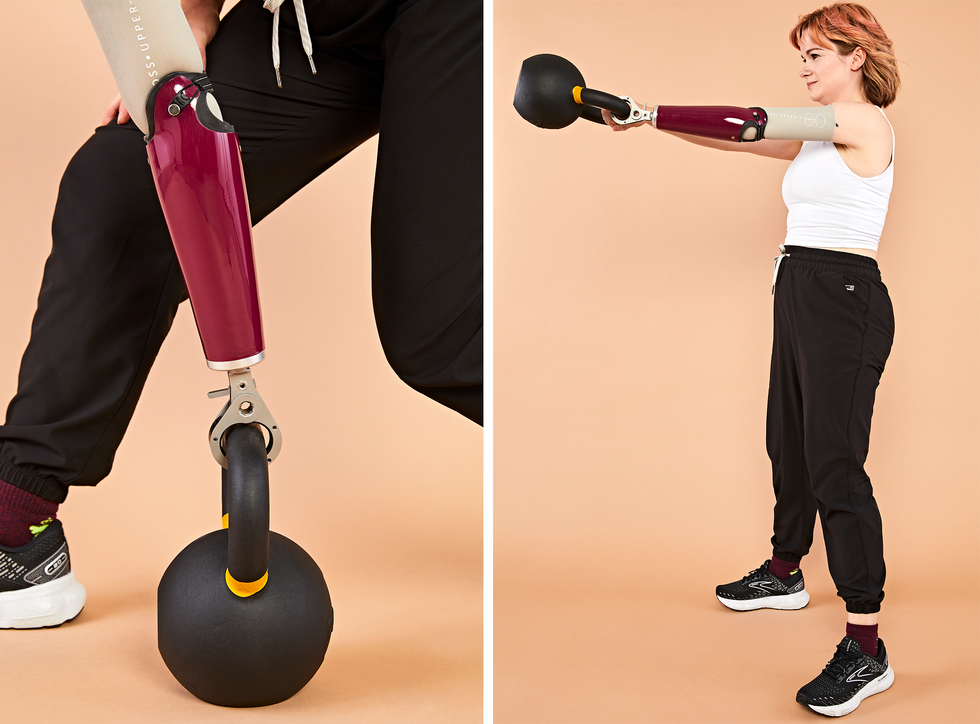 Activity arms, such as this one manufactured by prosthetics firm Arm Dynamics, are less expensive and more durable than bionic prostheses. The attachment from prosthetic-device company Texas Assistive Devices rated for very heavy weights, allowing the author to perform exercises that would be risky or impossible with her much more expensive bebionic arm.Gabriela Hasbun; Makeup: Maria Nguyen for MAC cosmetics; Hair: Joan Laqui for Living Proof
In recent decades, the overwhelming focus of research into and development of new artificial hands has been on perfecting different types of grasps. Many of the most expensive hands on the market differentiate themselves by the number and variety of selectable prehensile grips. My own media darling of a hand, the bebionic from Ottobock, which I received in 2018, has a fist-shaped power grip, pinching grips, and one very specific mode with thumb on top of index finger for politely handing over a credit card. My 21st-century myoelectric hand seemed remarkable—until I tried using it for some routine tasks, where it proved to be more cumbersome and time consuming than if I had simply left it on the couch. I couldn’t use it to pull a door shut, for example, a task I can do with my stump. And without the extremely expensive addition of a powered wrist, I couldn’t pour oatmeal from a pot into a bowl. Performing tasks the cool bionic way, even though it mimicked having two hands, wasn’t obviously better than doing things my way, sometimes with the help of my legs and feet.
When I first spoke with Ad Spiers, lecturer in robotics and machine learning at Imperial College London, it was late at night in his office, but he was still animated about robotic hands—the current focus of his research. Spiers says the anthropomorphic robotic hand is inescapable, from the reality of today’s prosthetics to the fantasy of sci-fi and anime. “In one of my first lectures here, I showed clips of movies and cartoons and how cool filmmakers make robot hands look,” Spiers says. “In the anime Gundam, there are so many close-ups of gigantic robot hands grabbing things like massive guns. But why does it need to be a human hand? Why doesn’t the robot just have a gun for a hand?”
It’s time to ask who prostheses are really for, and what we hope they will actually accomplish.
Spiers believes that prosthetic developers are too caught up in form over function. But he has talked to enough of them to know they don’t share his point of view: “I get the feeling that people love the idea of humans being great, and that hands are what make humans quite unique.” Nearly every university robotics department Spiers visits has an anthropomorphic robot hand in development. “This is what the future looks like,” he says, and he sounds a little exasperated. “But there are often better ways.”
The vast majority of people who use a prosthetic limb are unilateral amputees—people with amputations that affect only one side of the body—and they virtually always use their dominant “fleshy” hand for delicate tasks such as picking up a cup. Both unilateral and bilateral amputees also get help from their torsos, their feet, and other objects in their environment; rarely are tasks performed by a prosthesis alone. And yet, the common clinical evaluations to determine the success of a prosthetic are based on using only the prosthetic, without the help of other body parts. Such evaluations seem designed to demonstrate what the prosthetic hand can do rather than to determine how useful it actually is in the daily life of its user. Disabled people are still not the arbiters of prosthetic standards; we are still not at the heart of design.
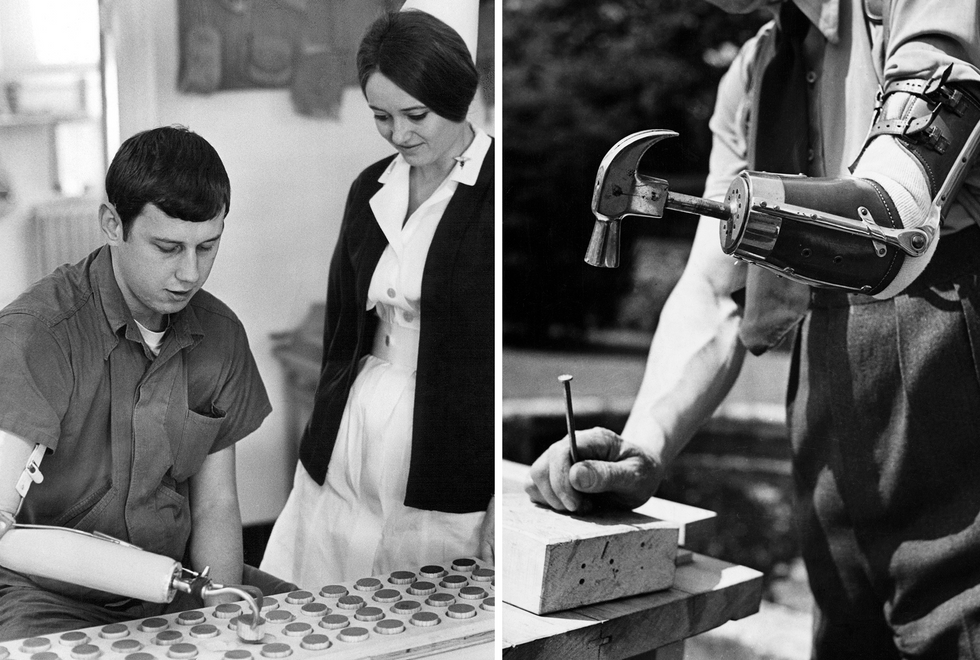 The Hosmer Hook [left], originally designed in 1920, is the terminal device on a body-powered design that is still used today. A hammer attachment [right] may be more effective than a gripping attachment when hammering nails into wood.Left: John Prieto/The Denver Post/Getty Images; Right: Hulton-Deutsch Collection/Corbis/Getty Images
To find out how prosthetic users live with their devices, Spiers led a study that used cameras worn on participants’ heads to record the daily actions of eight people with unilateral amputations or congenital limb differences. The study, published last year in IEEE Transactions on Medical Robotics and Bionics, included several varieties of myoelectric hands as well as body-powered systems, which use movements of the shoulder, chest, and upper arm transferred through a cable to mechanically operate a gripper at the end of a prosthesis. The research was conducted while Spiers was a research scientist at Yale University’s GRAB Lab, headed by Aaron Dollar. In addition to Dollar, he worked closely with grad student Jillian Cochran, who coauthored the study.
Watching raw footage from the study, I felt both sadness and camaraderie with the anonymous prosthesis users. The clips show the clumsiness, miscalculations, and accidental drops that are familiar to even very experienced prosthetic-hand users. Often, the prosthesis simply helps brace an object against the body to be handled by the other hand. Also apparent was how much time people spent preparing their myoelectric prostheses to carry out a task—it frequently took several extra seconds to manually or electronically rotate the wrists of their devices, line up the object to grab it just right, and work out the grip approach.The participant who hung a bottle of disinfectant spray on their “hook” hand while wiping down a kitchen counter seemed to be the one who had it all figured out.
In the study, prosthetic devices were used on average for only 19 percent of all recorded manipulations. In general, prostheses were employed in mostly nonprehensile actions, with the other, “intact” hand doing most of the grasping. The study highlighted big differences in usage between those with nonelectric, body-powered prosthetics and those with myoelectric prosthetics. For body-powered prosthetic users whose amputation was below the elbow, nearly 80 percent of prosthesis usage was nongrasping movement—pushing, pressing, pulling, hanging, and stabilizing. For myoelectric users, the device was used for grasping just 40 percent of the time.
More tellingly, body-powered users with nonelectric grippers or split hooks spent significantly less time performing tasks than did users with more complex prosthetic devices. Spiers and his team noted the fluidity and speed with which the former went about doing tasks in their homes. They were able to use their artificial hands almost instantaneously and even experience direct haptic feedback through the cable that drives such systems. The research also revealed little difference in use between myoelectric single-grasp devices and fancier myoelectric multiarticulated, multigrasp hands—except that users tended to avoid hanging objects from their multigrasp hands, seemingly out of fear of breaking them.
“We got the feeling that people with multigrasp myoelectric hands were quite tentative about their use,” says Spiers. It’s no wonder, since most myoelectric hands are priced over $20,000, are rarely approved by insurance, require frequent professional support to change grip patterns and other settings, and have costly and protracted repair processes. As prosthetic technologies become more complex and proprietary, the long-term serviceability is an increasing concern. Ideally, the device should be easily fixable by the user. And yet some prosthetic startups are pitching a subscription model, in which users continue to pay for access to repairs and support.
Despite the conclusions of his study, Spiers says the vast majority of prosthetics R&D remains focused on refining the grasping modes of expensive, high-tech bionic hands. Even beyond prosthetics, he says, manipulation studies in nonhuman primate research and robotics are overwhelmingly concerned with grasping: “Anything that isn’t grasping is just thrown away.”
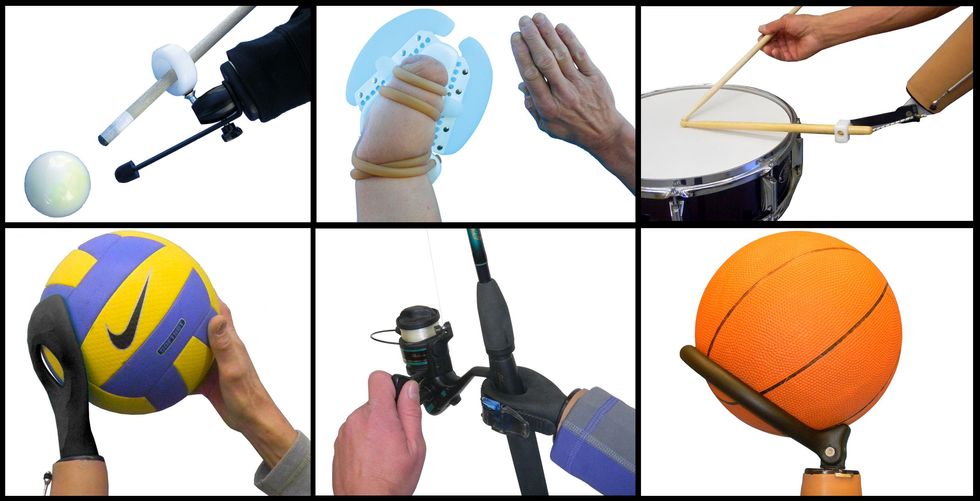 TRS makes a wide variety of body-powered prosthetic attachments for different hobbies and sports. Each attachment is specialized for a particular task, and they can be easily swapped for a variety of activities. Fillauer TRS
If we’ve decided that what makes us human is our hands, and what makes the hand unique is its ability to grasp, then the only prosthetic blueprint we have is the one attached to most people’s wrists. Yet the pursuit of the ultimate five-digit grasp isn’t necessarily the logical next step. In fact, history suggests that people haven’t always been fixated on perfectly re-creating the human hand.
As recounted in the 2001 essay collection Writing on Hands: Memory and Knowledge in Early Modern Europe, ideas about the hand evolved over the centuries. “The soul is like the hand; for the hand is the instrument of instruments,” Aristotle wrote in De Anima. He reasoned that humanity was deliberately endowed with the agile and prehensile hand because only our uniquely intelligent brains could make use of it—not as a mere utensil but a tool for apprehensio, or “grasping,” the world, literally and figuratively.
More than 1,000 years later, Aristotle’s ideas resonated with artists and thinkers of the Renaissance. For Leonardo da Vinci, the hand was the brain’s mediator with the world, and he went to exceptional lengths in his dissections and illustrations of the human hand to understand its principal components. His meticulous studies of the tendons and muscles of the forearm and hand led him to conclude that “although human ingenuity makes various inventions…it will never discover inventions more beautiful, more fitting or more direct than nature, because in her inventions nothing is lacking and nothing is superfluous.”
Da Vinci’s illustrations precipitated a wave of interest in human anatomy. Yet for all of the studious rendering of the human hand by European masters, the hand was regarded more as an inspiration than as an object to be replicated by mere mortals. In fact, it was widely accepted that the intricacies of the human hand evidenced divine design. No machine, declared the Christian philosopher William Paley, is “more artificial, or more evidently so” than the flexors of the hand, suggesting deliberate design by God.
Performing tasks the cool bionic way, even though it mimicked having two hands, wasn’t obviously better than doing things my way, sometimes with the help of my legs and feet.
By the mid-1700s, with the Industrial Revolution in the global north, a more mechanistic view of the world began to emerge, and the line between living things and machines began to blur. In her 2003 article “ Eighteenth-Century Wetware,” Jessica Riskin, professor of history at Stanford University, writes, “The period between the 1730s and the 1790s was one of simulation, in which mechanicians tried earnestly to collapse the gap between animate and artificial machinery.” This period saw significant changes in the design of prosthetic limbs. While mechanical prostheses of the 16th century were weighed down with iron and springs, a 1732 body-powered prosthesis used a pulley system to flex a hand made of lightweight copper. By the late 18th century, metal was being replaced with leather, parchment, and cork—softer materials that mimicked the stuff of life.
The techno-optimism of the early 20th century brought about another change in prosthetic design, says Wolf Schweitzer, a forensic pathologist at the Zurich Institute of Forensic Medicine and an amputee. He owns a wide variety of contemporary prosthetic arms and has the necessary experience to test them. He notes that anatomically correct prosthetic hands have been carved and forged for the better part of 2,000 years. And yet, he says, the 20th century’s body-powered split hook is “more modern,” its design more willing to break the mold of the human hand.
“The body powered arm—in terms of its symbolism—(still) expresses the man-machine symbolism of an industrial society of the 1920s,” writes Schweitzer in his prosthetic arm blog, “when man was to function as clockwork cogwheel on production lines or in agriculture.” In the original 1920s design of the Hosmer Hook, a loop inside the hook was placed just for tying shoes and another just for holding cigarettes. Those designs, Ad Spiers told me, were “incredibly functional, function over form. All pieces served a specific purpose.”
Schweitzer believes that as the need for manual labor decreased over the 20th century, prostheses that were high-functioning but not naturalistic were eclipsed by a new high-tech vision of the future: “bionic” hands. In 2006, the U.S. Defense Advanced Research Projects Agency launched Revolutionizing Prosthetics, a research initiative to develop the next generation of prosthetic arms with “near-natural” control. The $100 million program produced two multi-articulating prosthetic arms (one for research and another that costs over $50,000). More importantly, it influenced the creation of other similar prosthetics, establishing the bionic hand—as the military imagined it—as the holy grail in prosthetics. Today, the multigrasp bionic hand is hegemonic, a symbol of cyborg wholeness.
And yet some prosthetic developers are pursuing a different vision. TRS, based in Boulder, Colo., is one of the few manufacturers of activity-specific prosthetic attachments, which are often more durable and more financially accessible than robotic prosthetics. These plastic and silicone attachments, which include a squishy mushroom-shaped device for push-ups, a ratcheting clamp for lifting heavy weights, and a concave fin for swimming, have helped me experience the greatest functionality I have ever gotten out of a prosthetic arm.
Such low-tech activity prostheses and body-powered prostheses perform astonishingly well, for a tiny fraction of the cost of bionic hands. They don’t look or act like human hands, and they function all the better for it. According to Schweitzer, body-powered prostheses are regularly dismissed by engineers as “arcane” or derisively called “Captain Hook.” Future bionic shoulders and elbows may make a huge difference in the lives of people missing a limb up to their shoulder, assuming those devices can be made robust and affordable. But for Schweitzer and a large percentage of users dissatisfied with their myoelectric prosthesis, the prosthetic industry has yet to provide anything fundamentally better or cheaper than body-powered prostheses.
Bionic hands seek to make disabled people “whole,” to have us participate in a world that is culturally two-handed. But it’s more important that we get to live the lives we want, with access to the tools we need, than it is to make us look like everyone else. While many limb-different people have used bionic hands to interact with the world and express themselves, the centuries-long effort to perfect the bionic hand rarely centers on our lived experiences and what we want to do in our lives.
We’ve been promised a breakthrough in prosthetic technology for the better part of 100 years now. I’m reminded of the scientific excitement around lab-grown meat, which seems simultaneously like an explosive shift and a sign of intellectual capitulation, in which political and cultural change is passed over in favor of a technological fix. With the cast of characters in the world of prosthetics—doctors, insurance companies, engineers, prosthetists, and the military—playing the same roles they have for decades, it’s nearly impossible to produce something truly revolutionary.
In the meantime, this metaphorical race to the moon is a mission that has forgotten its original concern: helping disabled people acquire and use the tools they want. There are inexpensive, accessible, low-tech prosthetics that are available right now and that need investments in innovation to further bring down costs and improve functionality. And in the United States at least, there is a broken insurance system that needs fixing. Releasing ourselves from the bionic-hand arms race can open up the possibilities of more functional designs that are more useful and affordable, and might help us bring our prosthetic aspirations back down to earth.
This article appears in the October 2022 print issue.

These SEM images of a microscopic octahedral truss structure are shown at 100-micrometer scale [left] and zoomed in at 10-µm scale [right], where the yellow structure shows an individual unit cell.
However, two-photon lithography has proven too slow and expensive for large-scale practical applications. This has largely rendered it an expensive laboratory tool to produce microscopic prototypes.
The new method can manufacture complex, microscopic 3D objects such as letters, numbers, rings, lenses, and gears that can be remotely controlled by applying a magnetic field.
Previous research has sought to split the laser beam used in two-photon lithography into multiple focal points to speed up fabrication. However, this strategy typically still achieves printing speeds of only about 10,000 voxels per second and less than 0.1 cubic millimeters per hour. Moreover, this approach is usually not able to control each individual laser’s focus, and so cannot produce highly variable structures.
Now a new two-photon lithography technique can print nanoscale 3D objects at speeds of up to 2 million voxels per second and 4.5 to 54 cubic millimeters per hour. In addition, it achieved a resolution of up to 90 nanometers, the best seen yet in high-throughput two-photon lithography, the scientists noted. Moreover, the team’s new process can simultaneously operate up to 2,000 individually programmable laser foci to fabricate complex structures, the most seen yet in high-throughput two-photon lithography, they added.
“The increase in throughput means the cost is substantially reduced, and the technology can now be used for industrial-scale applications at a more reasonable price and fabrication rate,” says study senior author Shih-Chi Chen, an optical scientist and mechanical engineer at the Chinese University of Hong Kong.
Solidifying the resin used in two-photon lithography requires extremely high laser intensities. Using multiple laser foci increases the laser power required, and the lasers typically used in two-photon lithography can barely provide the power needed to support more than 50 foci. In contrast, the new method used a near-infrared laser with a peak power of approximately 10 gigawatts.
Usually, two-photon lithography relies on foci that receive about 10,000 low-power laser pulses in order to fully solidify a voxel. However, the new technique uses a laser that fires tens to hundreds of thousands of times slower than the lasers typically used in two-photon lithography. To compensate, the new technique uses a single pulse to solidify each voxel. This required significant tinkering with the light-sensitive resin to optimize its printing quality, the scientists said.
“We achieved the best resolution with single-pulse exposure, which is totally opposite to the conventional approach to achieve high resolution—that is, low average power and long exposure time,” Chen says.
The new method fires a thousand 100-femtosecond-long pulses per second, bouncing these pulses off a digital micromirror device that displays a hologram. The scientists could use the hologram to divide each laser pulse into up to 2,000 foci with individually controllable strength, location and phase that could operate simultaneously in parallel.
In experiments, the researchers showed their new method could manufacture complex, microscopic 3D objects such as letters, numbers, rings, lenses, and eggbeater-like structures. They also fabricated magnetic gears they could remotely control by applying a magnetic field.
 These 14 images reveal the range of nanostructures the new holographic technique can fabricate, including magnetic nanoscale gear wheels that could be remotely moved by applying a magnetic field [insets m and n].Chinese University of Hong Kong
In the new study, the scientists also revealed they could modify the laser power of each focus to achieve 11 different intensity levels. This “gray-scale control” may find use in adjusting the solidity and mechanical properties of each voxel. The new technique displayed gray-scale control with an accuracy of more than 99 percent, the highest seen yet in parallel two-photon lithography, the scientists noted.
In addition, the researchers reported, the new method yields the highest energy efficiency yet in two-photon lithography. Whereas other techniques demand an operating power of roughly 1.5 to 4 watts, the new method requires only an average power of 400 milliwatts to operate 2,000 foci.
One potential application for nanoscale 3D printing is fabricating metastructures—materials whose structures possess repeating patterns at scales that are smaller than the wavelengths of whatever force they are designed to influence. Optical metastructures, which are designed to manipulate electromagnetic radiation, can bend light in unexpected ways, resulting in invisibility cloaks and other devices.
One of the greatest challenges with research into metastructures is manufacturing objects containing subfeatures less than a micrometer in size but, on the whole, are many thousands of times as large as their subfeatures. In experiments, the scientists revealed their new technique could fabricate a grid roughly 1 cubic millimeter in size made up of more than 680,000 cells with subfeatures as small as 700 nanometers.
The researchers are now exploring using AI to generate optimal fabrication procedures with their new technique. The aim is for the products to “have better structural integrity, strength, and uniformity,” Chen says.
The scientists detailed their findings online 27 March in the journal Nature Communications.

That’s the goal Elephant Robotics aims to achieve with its line of lightweight, smart, and capable robots. The company has launched several desktop collaborative robots over the past few years, including the myCobot, mechArm, and myPalletizer. To help users achieve more applications in education, Elephant Robotics has also launched AI Robot Kit, a robotic kit that integrates multiple functions like vision, positioning grabbing, and automatic sorting modules. This year, the company is unveiling completely improved and upgraded products to make robotics even more accessible in education.
Schools in different countries and regions have been using Elephant Robotics’ robotic arms and AI Kits as educational tools in recent years. The products’ portability, ease of use, and cost-effectiveness have helped schools integrate robotics as part of their programs and courses. The performance of the products and the wide range of built-in software and features help students learn better about robotics and programming. Using the robotic arms and AI Kit, students can learn about artificial intelligence and applications such as robot vision, object recognition, manipulation, and more.
To help more students experience robots and start learning about robotics and programming at a young age, Elephant Robotics has upgraded its AI Kit to make it more powerful and even easier to use.
Elephant Robotics has upgraded the AI Kit comprehensively, improving the quality of the hardware while optimizing the built-in algorithms and software to make the product more flexible and scalable. Video: Elephant Robotics
In addition to the upgraded AI Kit, Elephant Robotics this year released new robotics and AI education material, starting with a book called “Machine Vision and Robotics.” The book explains the topics of robotic arms and vision sensors, and includes five algorithm courses, plus tutorials on programming languages. Users learn about machine vision in a practical way by experimenting with the AI Kit through a series of examples and applications.
Elephant Robotics also provides users visualization software and customization options to select the built-in algorithms. The software is very friendly for new robotics users who have yet to gain programming experience. AI Kit 2023 uses a camera with higher accuracy and light adjustment for the hardware to make the robotic arm more efficient in object recognition. The suction pump installed at the end of the robotic arm has also been improved, which has higher adaptability and stability when working with different robotic arms.
Elephant Robotics has also upgraded the myCobot product into a new version: myCobot 2023, which features more user-friendly software. myCobot 2023 allows users to use their mobile phone and gamepad to control the robotic arm and accessories, helping to learn and develop remote wireless operations. To improve safety, Elephant Robotics has added algorithms to the robotic arm to prevent it from colliding with other objects while in operation.
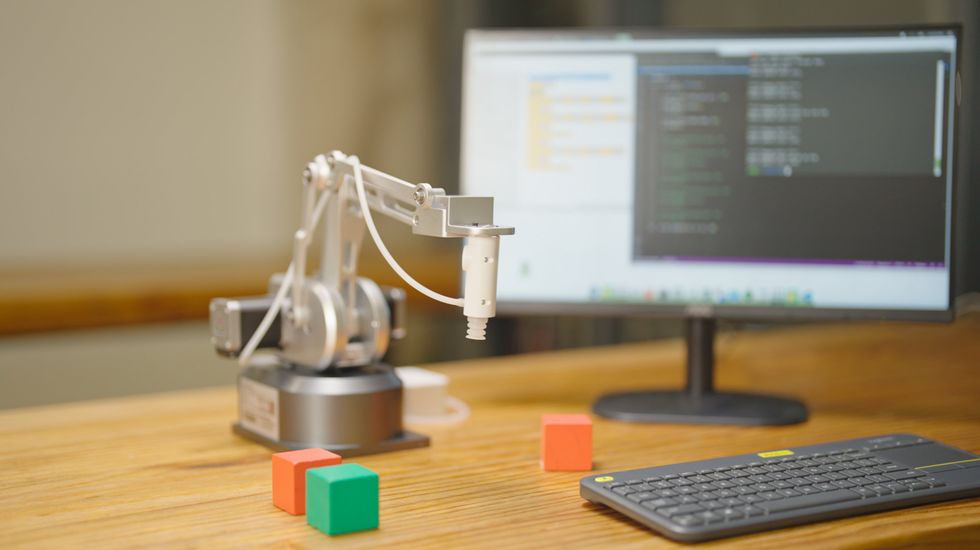
The ultraArm P340 is a high-performance robotic arm that features metal construction, stepper motors, and repeatable positioning accuracy to ±0.1mm.
Elephant Robotics
In 2023, Elephant Robotics is also introducing the ultraArm P340, a high-performance robotic arm designed to meet educational needs. ultraArm uses metal construction to increase the stiffness and its payload capabilities. To provide further stability, the ultraArm P340 also features stepper motors, which improves its speed and provides repeatable positioning accuracy to ±0.1mm.
Elephant Robotics has still more products to announce this year: The company has launched five kits with ultraArm that provide additional applications for the education field. The Vision educational kits include the Vision & Picking Kit, Vision & Conveyor Belt Kit, and Vision & Slide Rail Kit. These kits help users learn about machine vision and experiment with industrial-like applications such as dynamic and static intelligent recognition and grasping.
There are two kits in the DIY series: the Drawing Kit and Laser Engraving Kit. This series helps makers achieve high quality reproduction of drawings and laser engraving applications, developing users’ creativity and imagination. To help users quickly achieve DIY production, Elephant Robotics created software called Elephant Luban. It is a platform that generates the G-Code track and provides primary cases for users. Users can select multiple functions, such as drawing and laser engraving, with just a few clicks.
Combined with different robotics kits, the ultraArm is an excellent and affordable option for many educational applications. These kits offer students the possibility of learning and experimenting with advanced, complex robotics and AI tools that are fun and easy to use.
And this has long been one of Elephant Robotics‘s main goals: creating innovative products that are specifically designed to provide students with hands-on experience and promote STEM education. The company is committed to keep pursuing that goal by continuing to research and contribute to the development of even better educational robots in the future.


